OPG’s Des Joachims hydro station celebrates 75 years of generating reliable, low-carbon power
Upcoming events
No posts found.

At a glance
- In eastern Ontario, Des Joachims Generating Station marks three-quarters of a century in service.
- The plant with a unique name began operating in 1950 as part of Ontario’s great post-war hydro expansion.
- OPG continues to invest in Des Joachims’ maintenance to ensure it can continue to operate reliably for decades to come. The station is set to undergo a refurbishment in the coming years.
On the Ottawa River, near the town of Rolphton, a major hydro station with a unique name is celebrating its 75th year of producing low-carbon, reliable power for Ontario.

OPG’s Des Joachims Generating Station (GS)—better known by its local nickname, “Da Swisha”—marks three-quarters of a century in service this summer.
When it was officially opened in June 1950 by then-Ontario Hydro chairman R.H. Saunders, Des Joachims was one of the largest hydro stations in the province. Its development was part of Ontario’s great post-war expansion of hydroelectricity to support its booming economy.
Alongside the nearby Chenaux GS, the station helped transform the Ottawa River into a key source of renewable energy.
Now, Des Joachims GS is set to be refurbished in the coming years, alongside seven other hydro stations in eastern Ontario, to ensure it can continue to support Ontario’s electrification and economic growth for many more decades.
But how exactly do you pronounce Des Joachims? Named after two brothers of the Joachims family who formerly owned great tracts of land in the nearby area, the French pronunciation of Des Joachims roughly sounds like “day-swa-shem”. But, over time, this pronunciation was affectionally shortened to “Da Swisha” by locals and workers who built and operated the station.
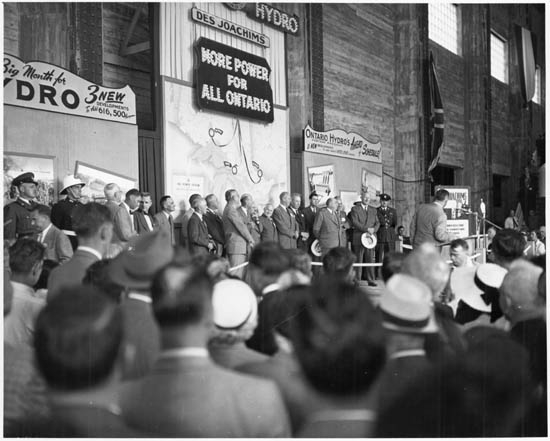
The name has stuck and so has the station’s reputation as a reliable source of clean power.
Situated deep in the Ottawa Valley between Quebec and Ontario, the 430-megawatt, eight-unit facility is the fourth-largest station in OPG’s hydro fleet and the largest on the Ottawa River. It produces enough electricity to power more than 320,000 homes.
The station’s construction led to the creation of a small village to house the workers who built and ran it—a community that thrived alongside the station for decades. The village included comfortable living quarters, as well as recreational buildings, and even a 30-bed hospital.
During peak construction, more than 3,100 workers were employed. A total of 672,848 cubic metres of concrete went into building the massive station, enough to pave a standard one metre-wide sidewalk across Canada.

Today, Des Joachims continues to generate power reliably. To ensure the station can continue to perform well for decades to come, and support Ontario’s electrification and growth, OPG has continued to invest in the station’s routine maintenance and upkeep.
And in the coming years, Des Joachims will be refurbished as part of OPG’s plan to invest $1 billion over the next 20 years to refurbish eight hydro stations in eastern Ontario.
As Ontario’s demand for clean electricity continues to grow, stations like Des Joachims will be important as ever. The station’s longevity proves that with the right care, hydro infrastructure built decades ago can continue powering the province far into the future.
Learn more about how OPG harnesses the power of water to generate renewable electricity here.

Related stories
Subscribe and stay informed
Sign up to receive the latest news, project updates, and event information from OPG.